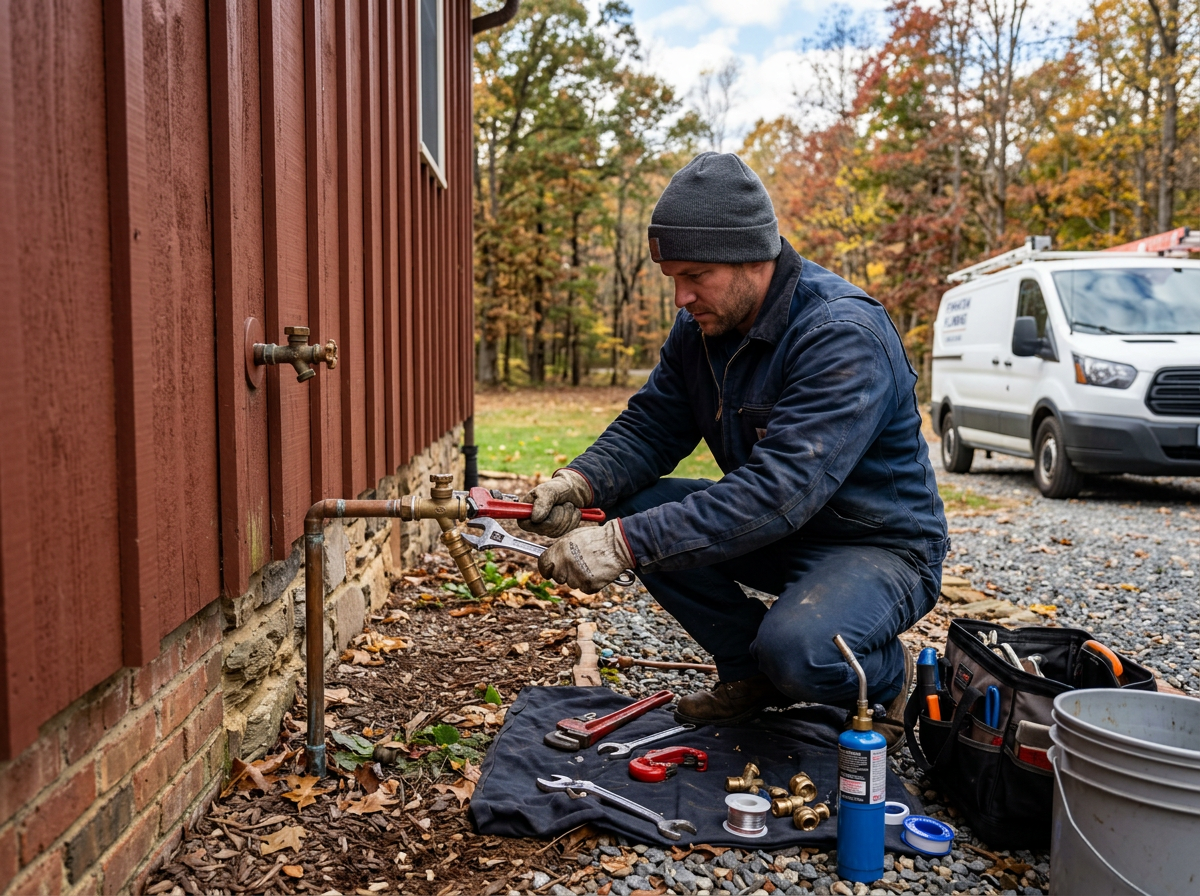
Outdoor spigots live a hard life. They sit in the sun all summer, freeze in the winter, and get a hose yanked on them every week. On a rural Powhatan property there are often several: at the house, the garden, the barn or the workshop, each one a place a leak can start.
Signs your spigot needs attention
- Dripping from the spout when it's turned off
- Water leaking from around the handle while in use
- Water running down the wall or pooling at the foundation
- A handle that spins without shutting the water off
- Low or no flow
- Water inside the house near where the spigot comes through the wall
Why the wall leak is the one to worry about
A drip at the spout wastes water. A leak where the pipe passes through the wall puts water into the rim joist, the crawlspace or the basement. That is usually a pipe that split during a freeze, and it often shows up only the first time the hose is used in spring. If you see water inside near the spigot, shut off its inside valve, or the main, and call.
How it's repaired
A dripping spigot can often be repaired with a new washer, packing or stem. A spigot that is corroded, cracked or leaking at the wall is replaced. Where the spigot has frozen before, replacing it with a frost-free model is usually the better long-term fix; see our frost-free spigot repair page.
Inside taps dripping too? See leaking faucet repair. Weak flow everywhere? Read low water pressure at the faucet.
Call for a quote on faucet and spigot repair for your property.
How it works
- 1
Inspect
Spout, handle, wall penetration and inside valve checked.
- 2
Repair or replace
Washer, packing and stem, or a new spigot.
- 3
Seal the wall
The penetration sealed against water and drafts.
- 4
Test
Run with a hose attached and checked inside.